Major Grants
Watson A, Johns A, Walsh T and Morley C. Bridging the Divide: Public Libraries and the Digital-Social Inequality Loop. UNSW-UTS Trustworthy Digital Society. $119,022. This project aims to generate new data on the emergent digital-social ‘inequality loop’ and enable libraries to better address under-discussed social and cultural barriers to digital inclusion. 2025-2026.
Long P, Watson A, Alizadeh A, Homan S and Bartindale T. Mapping Australian Homemade, Amateur & Do-it-Yourself Cultural Economies. ARC Discovery Project (DP240102301). $561,545. This project aims to develop new understandings of non-professional creatives and the function of everyday creativity in building contemporary community, including a focus on digital connections and practices. 2024-2027.
Watson A. Directions for Public Sociology. Australia Awards — Endeavour Research Fellowship. $24,500. This six-month fellowship supported methodological development in creative and ethnographic sociological research approaches at Goldsmiths, University of London. 2017.
Monograph
Lupton D, Southerton C, Clark M and Watson A (2021) The Face Mask in COVID Times: A sociomaterial analysis. De Gruyter. On the first months of the pandemic and how face masks were rolled out (and resisted) across the world. Includes analysis of the DIY community cultures and online networks that supported the crowdsourced production of face masks for those in need.
Novel
Watson A (2020) Into the Sea. Brill. This major non-traditional research output is an arts-based research novel grounded in ethnographic work on ‘the Australian way of life’. Engaging with sociological and Spinozan concepts, a glocal frame sees contemporary cultural tensions play out through the panoramic dimensions of relationships and life events.
Journal Articles
Watson A and Lupton D (2026) Data Feelings: Everyday Affects and Sensory Dimensions of Personal Digital Data. International Journal of Communication. 20(2026): 336-357. Featured in a special section on big data discourses, this article shares findings on how people feel about and with the digital data that their technology use generates.
Watson A (2025) Vibes-based methods. Qualitative Research. 25(6): 1326-1343. This article considers the importance of ‘vibes’ in social life today and how vibes-based methods can help us wrestle with the generative ambiguities of people’s lived experiences.
Watson A (2025) Researching futures with speculative fiction. Journal of Creative Research Methods 1(1): 55–71. Featured in the inaugural issue of a new creative methods journal, this article shows the value of speculative fiction and sci-fi for researching how people perceive and feel about the future.
Rodriguez Castro L, Watson A and Trayhurn S (2025) Critical feminist zine-making as method and pedagogy: reflections on a zine workshop series. Gender and Education. OnlineFirst. This article examines the methodological and pedagogical potentials of feminist zine-making and draws on the AKE Zine series.
Watson A (2025) Fanzines: A review. DIY, Alternative Cultures & Society. OnlineFirst. This article reviews major themes within zine research and within fanzines themselves, offering readers ways to navigate the research literature on this participatory form of alternative cultural production.
Watson A, Grasso Z, Zon C and Long P (2025) Zine-making the commons: Reflections on a DIY workshop. European Journal of Cultural Studies. OnlineFirst. This article reflects on the zine-making workshop as a potential commons space, generative for thinking about everyday forms of creativity.
Watson A and Kirby E (2025) Desire lines, queer cartographies and cartographic queers. Environment and Planning D: Society and Space. OnlineFirst. This article analyses queeringthemap.com, how and why people contribute to this queer mapping of life, and introduces the concept of cartographic queers.
Watson A (2025) Patricia Leavy’s Spark as a Novel and Metaphor for Creative Interdisciplinary Research. The Qualitative Report 30(2): 3186-3192. This article offers a close reading of Leavy’s sociological novel, reflecting on the research tensions and everyday materialities represented that raise valuable questions for interdisciplinary collaboration.
Watson A (2025) An imperative to innovate? Crisis in the sociotechnical imaginary. Telematics and Informatics. Online First. This article examines how innovation and vulnerable publics are being conceptualised within contemporary contexts of crisis. It shows how crises such as pandemics, wildfires and floods are seen as vital opportunities for tech development, as intense times when innovation may be – and must be – advanced.
Lupton D, Watson A and Wozniak-O’Connor (2025) ‘It’s all about connecting’: using visual methods to surface the multisensory and more-than-human dimensions of health information. Visual Studies 40(2): 227-241. This article explores the everyday dimensions health information, expanding a focus on digital health data to include the importance of other people and places, through an analysis of participants’ hand-drawn maps and their poetic responses to photographs.
Watson A and Wozniak-O’Connor V (2024) The promise of artificial intelligence in health: Portrayals of emerging healthcare technologies. Sociology of Health and Illness 47(1): e13840. This article categories the leading uses of AI in healthcare today: for monitoring and tracking, for data management and analysis, in cloud computing, and in robotics. It considers the implications of promissory discourses for how new technologies are understood and adopted in healthcare contexts.
Watson A and Kirby E (2024) Affective routes in interviews: Participants exploring a digital map as a live elicitation method. Qualitative Research. OnlineFirst. This methodological article reflects on a project involving the online archival platform Queering the Map; it shows how techniques of elicitation can open reflective dialogic spaces between participants and researchers, bridging memory and meaning.
Watson A, Kirby E, Churchill B, Robards B and LaRochelle L (2024). What matters in the queer archive? Technologies of memory and Queering the Map. The Sociological Review 72(1): 99-117. This article considers how and why (digital/counter) archives make the act of archiving meaningful to queer people, and what moves people to contribute stories from their own life.
Watson A, Lupton D and Michael M (2023) The presence and perceptibility of personal digital data: Findings from a participant map drawing method. Visual Studies 38(3-4): 594-607. This article shares findings from an analysis of participants’ hand-drawn maps of their homes, focusing on what is visible and perceptible about their digital technologies and personal data.
Lupton D, Wozniak-O’Connor V, Rose M and Watson A (2023) More-than-human wellbeing: Materialising the relations, affects, and agencies of health, kinship and care. M/C Journal 26(4). This article discusses select artworks from a creative knowledge translation exhibition on the digital, natural and human dimensions of health and wellbeing.
Watson A, Wozniak-O’Connor V and Lupton D (2023) Health information in creative translation: Establishing a collaborative project of research and exhibition making. Health Sociology Review 23(1): 42-59. This article discusses the first stages of a project on health information ecologies that included a creative public exhibition, part of a special issue on knowledge translation.
Watson A (2022) The familiar strange of sociological fiction. The Sociological Review 70(4): 723-732. Part of a special issue/monograph on writing differently about the social world, this article reflects on the unsettling character of sociological stories and what we can learn about storytelling from Gabriel García Márquez.
Lupton D and Watson A (2022) Research-creations for speculating about digitised automation: Bringing creative writing prompts and vital materialism into the sociology of futures. Qualitative Inquiry 28(7): 754-766. This article discusses participants’ speculative imaginaries about the futures of personal data generating devices.
Watson A and Lupton D (2022) What happens next? Using the story completion method to surface the affects and materialities of digital privacy dilemmas. Sociological Research Online 27(3): 690-706. This article considers what participants’ short fiction reveals about digital privacy problems in everyday life.
Watson A (2022) Writing sociological fiction. Qualitative Research 22(3): 337-352. This methodological article outlines how sociological imagination may be crafted in/with fiction.
Watson A and Lupton D (2022) Remote fieldwork in homes during the COVID-19 pandemic: Video-call ethnography and map drawing methods. International Journal of Qualitative Methods 21: 1-12. This open access article reflects on the challenges and opportunities of transitioning an in-person ethnographic project online during the pandemic using creative qualitative and visual methods.
Watson A, Lupton D and Michael M (2021) The COVID digital home assemblage: Transforming the home into a work space during the crisis. Convergence: The International Journal of Research into New Media Technologies 27(5): 1207-1221. Part of a special issue on smart homes, this article analyses how people reconfigured their home environments during lockdown.
Watson A and Bennett A (2021) The felt value of reading zines. American Journal of Cultural Sociology 9(2): 115-149. Part of a special issue on the cultural sociology of reading, this article draws on a collection of zines and interviews with Australian readers to make sense of the medium’s iconicity and contemporary salience.
Watson A, Lupton D and Michael M (2021) Enacting intimacy and sociality at a distance in the COVID-19 crisis: the sociomaterialities of home-based communication technologies. Media International Australia 178(1): 136-150. This article shares findings from a video ethnography project and identifies how digital technologies supported and enhanced intimacy and social connection throughout the first months of the pandemic.
Kirby E, Watson A, Churchill B, Robards B and LaRochelle L (2021) Queering the map: stories of love, loss and (be)longing within a digital cartographic archive. Media, Culture and Society 43(6): 1043-1060. This article explores stories posted to queeringthemap.com that, rather than being for a general audience, seem to have someone specific in mind — like notes left in a special book in the library, in the hope that someone will find it because they were thinking about you too.
Watson A and Lupton D (2021) Tactics, affects and agencies in digital privacy narratives: a story completion study. Online Information Review 45(1): 138-156. This article explores how Australians feel about digital privacy, using a novel creative method where participants completed short fictional stories about different privacy scenarios.
Lupton D and Watson A (2021) Towards more-than-human digital data studies: Developing research-creation methods. Qualitative Research 21(4): 463-480. This article offers a theoretical framework and a set of creative approaches for exploring the sociomaterial and affective dimensions of personal digital data.
Byron P, McKee A, Watson A, Litsou K and Ingham R (2021) Reading for realness: porn literacies, digital media and young people. Sexuality & Culture 25(3): 786-805. This article considers the limitations of dominant approaches to researching young people’s uses of porn.
Baker S, Buttigieg B, Cantillon Z, Pavlidis A, Rodriguez Castro L and Watson A (2021) Getting students to ‘do’ introductory sociology: Analysis of a blended and flipped interactive workshop. Journal of Sociology 57(3): 612-630. Authorship order is alphabetical. This article reflects on the implementation of a blended and flipped classroom for a first-year sociology unit.
Watson A (2020) Methods braiding: A technique for arts-based and mixed-methods research. Sociological Research Online 25(1): 66-83. This article introduces an innovative mixed methods technique that brings together insights from/for qualitative and arts-based research.
Watson A (2016) Directions for public sociology: Novel writing as a creative approach. Cultural Sociology 10(4): 431-447. This article argues that novel writing presents sociologists with a process and medium through which they can expand their work for a more public, engaging, affective, and panoramic sociology.
Book Chapters
Lupton D, Wozniak-O’Connor V and Watson A (2024) Arts-based and sensory methods to imagine more-than-human automated futures. In: Fors V, Berg M and Brodersen M (Eds), The DeGruyter Handbook of Automated Futures. De Gruyter.
Lupton D, Watson A and Wozniak-O’Connor V (2023) Sensory engagements with lively data: Attuning to the convivialities of more-than-human worlds. In: Vannini P (Ed) The Routledge International Handbook of Sensory Ethnography. Routledge.
Watson A (2023) Youth, zines and music scenes. In: A Bennett (Ed) The Bloomsbury Handbook of Popular Music and Youth Culture. Bloomsbury.
Watson A and Bennett A (2022) Why do people read zines? Meaning, materiality and cultures of reading. In: A Thumala Olave (Ed) The Cultural Sociology of Reading. Palgrave Macmillan, pp. 65-89
Southerton C, Clark M, Watson A and Lupton D (2022) The futures of qualitative research in the COVID-19 era: Experimenting with creative and digital methods. In: S Matthewman (Ed) A Research Agenda for COVID-19 and Society. Edward Elgar Publishing.
Byron P, McKee A, Watson A, Litsou K and Ingham R (2022) Pornography and porn literacy. In: McKee A, Litsou K, Byron P and Ingham R (Eds) What Do We Know About the Effects of Pornography After 50 Years of Academic Research? Routledge.
Special Issues & Editorials
Watson A (2021) Editorial: Popular Music Fiction. Riffs: Experimental Writing on Popular Music 5(1): 4-5. This editorial opens an invited special issue of Riffs on popular music and fiction.
Watson A and Smartt-Gullion J (2021) Editorial: Fiction as Research – Writing Beyond the Boundary Lines. Art/Research International: A Transdisciplinary Journal 6(1): i-vi. This editorial article opens an invited special issue of Art/Research International on fiction as a social research method.
Book Reviews
Watson A (2019) Book Review: Les Back and Shamser Sinha, Migrant City. Journal of Sociology 55(1): 184-186.
Watson A (2019) Book Review: Spark. Cultural Sociology 13(4): 528-529.
Watson A (2019) Spark: A Book Review. The Qualitative Report 24(5): 1052-1054.
Watson A (2016) Girlhood and the Politics of Place. Children, Youth and Environments 26(2): 157-158.
Essays
Watson A (2025) Vibes are something we feel but can’t quite explain. Now researchers want to study them. The Conversation. February 19.
Watson A and Ortmann M (2024) Reflecting on the aesthetic form of ideas: Ash Watson in conversation with Marc Ortmann. Soziopolis. March 20.
Watson A (2024) 2023: The Year in Sociological Fiction. The Sociological Review magazine. February 9.
Watson A, Clark M, Southerton C and Lupton D (2021) Fieldwork at your fingertips: creative methods for social research under lockdown. Nature, career column. March 3.
Lupton D, Watson A, Southerton C and Clark M (2020) From scary pumpkins to bridal bling, how masks are becoming a normal part of our lives in Australia. The Conversation. October 30.
Watson A (2019) Possessed by a Sense of the Trap. Overland. November 21.
Reports
Watson A, Wozniak-O’Connor V and Lupton D (2023) Creative Approaches to Health Information Ecologies: Summary Report. UNSW Sydney and ARC Centre of Excellence for Automated Decision-Making and Society.
O’Neill C, Sadowski J, Andrejevic M, van Toorn G, Lewis K, Lobato R, Binns D, Watson A and Wozniak-O’Connor V (2022) Social Issues in Automated Decision-Making: Preliminary Report. ARC Centre of Excellence for Automated Decision-Making.
Refereed Conference Papers
2020. Ash Watson, Brady Robards, Emma Kirby, Brendan Churchill and Lucas LaRochelle. Queering the Map: Physical Traces and Digital Places of Queer Lives. Association of Internet Researchers Annual Conference. Online. October 26.
Exhibitions
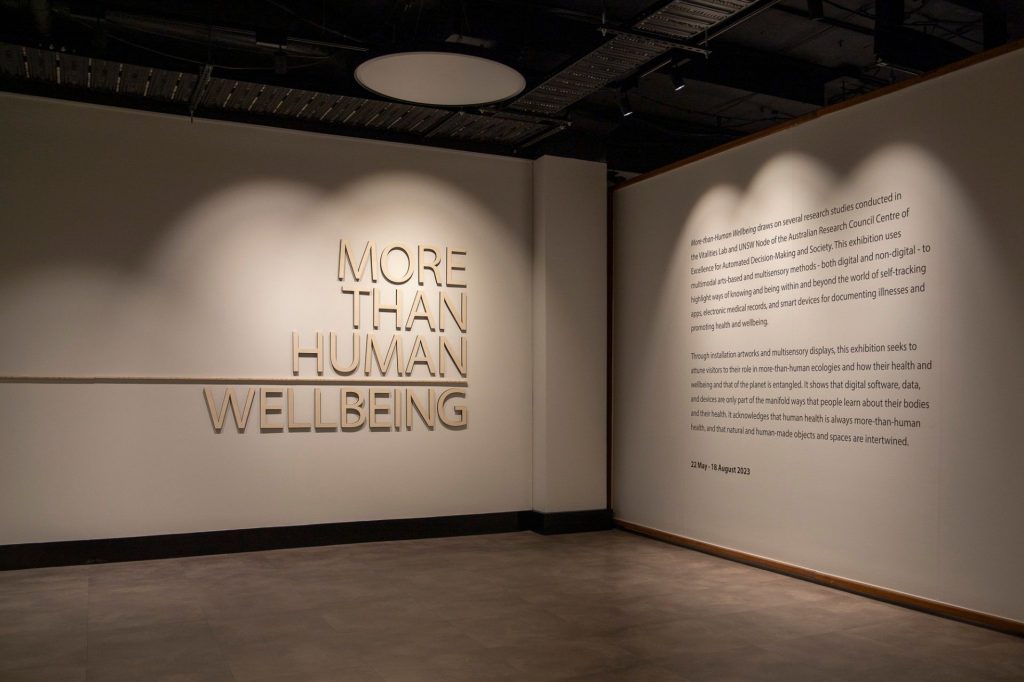
2023. Lupton D, Wozniak-O’Connor V, Rose M and Watson A. More-than-Human Wellbeing. UNSW Library Gallery, 22 May to 18 August. Through installation artworks and multisensory displays, this exhibition expands from digital ways of documenting health information to explore how our wellbeing is entangled with that of the planet. See here for more detail.

Podcasts
2020. Ash Watson on using Zoom to conduct home visits. Unlocking Lockdown: Doing Fieldwork in a Pandemic. Culture, Politics and Global Justice, Faculty of Education, University of Cambridge.
Youtube
2022-2023. Artificial Artificial Intelligence: in-conversation series. ARC Centre of Excellence for Automated Decision-Making and Society.
2020. Book Launch – Into the Sea. The Australian Sociological Association annual conference.
2020. Social Science Fiction. Social Sciences Week Australia. Supported by The Sociological Review and Vitalities Lab, UNSW.
2020. Zine Making as a Method. Breaking Methods Webinar Series, Vitalities Lab UNSW Sydney.
2020. Methods Braiding. Breaking Methods Webinar Series, Vitalities Lab UNSW Sydney.
 home
home 